

Our paper on “Storage and Retrieval of Electronic Spin Coherence using Nuclear Spins in a Vanadyl Paddlewheel” is finally online on Journal of the American Chemical Society (J.A.C.S.): https://doi.org/10.1021/jacs.6c10524
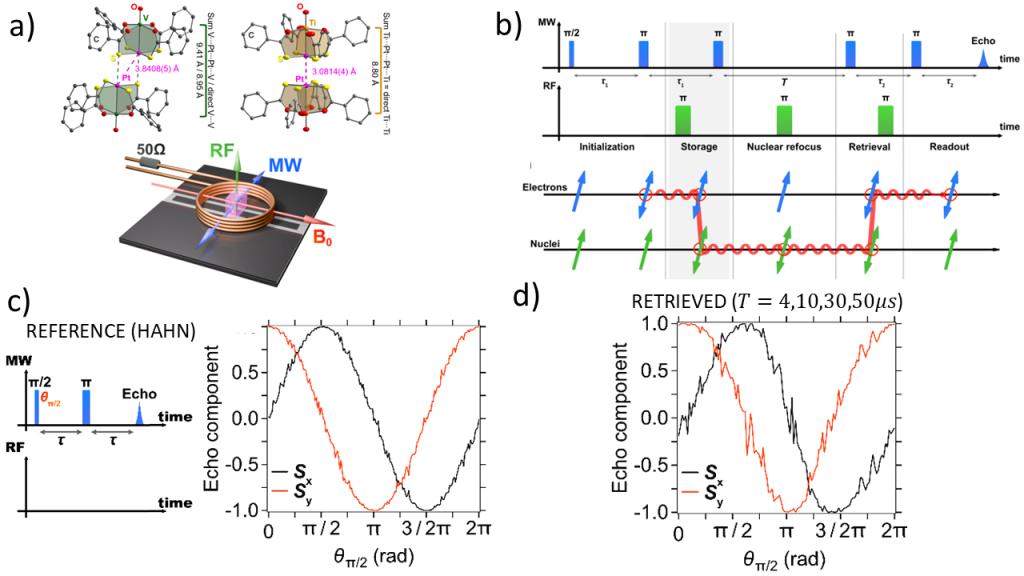
Abstract: Electronic and nuclear spins are complementary carriers of quantum information: whereas nuclear spins exhibit long coherence times suitable for information storage, electronic spins ensure rapid addressing and readout. A key challenge is harvesting the benefits of both spin degrees of freedom by transferring coherence between them. In this work, we achieved this goal by working on a molecular architecture that affords precise control over the hyperfine multiplets, spin dispersion, and molecular orientation within a crystalline host. As a model system, we used heterobimetallic paddlewheel complex [VOPt(SOCPh)4] diluted in [TiOPt(SOCPh)4]·2THF diamagnetic crystalline host matrix (nominal concentrations of 1 and 10%). In [VOPt(SOCPh)4], vanadyl electronic spin S = 1/2 is hyperfinely coupled to the nuclear spin I = 7/2 of 51V. These electronic and nuclear spins were simultaneously manipulated using sequences of radiofrequency (RF) and microwave (MW) pulses generated by a multifrequency on-chip setup operating at a cryogenic temperature. First, Electron-Nuclear DOuble Resonance (ENDOR) experiments were performed to show the readout of the 51V nuclear spin transitions through the electronic spin echo. Further experiments with a dedicated RF-MW pulse sequence demonstrated that electronic phase coherence can be stored in the nuclear spins and retrieved (Storage and Retrieval, SR) after a total free precession time that greatly exceeds the electronic phase memory time. This result demonstrates the possibility of simultaneous manipulation of electronic and nuclear spins and establishes a route for encoding quantum information on both degrees of freedom of a chemically tunable platform.