
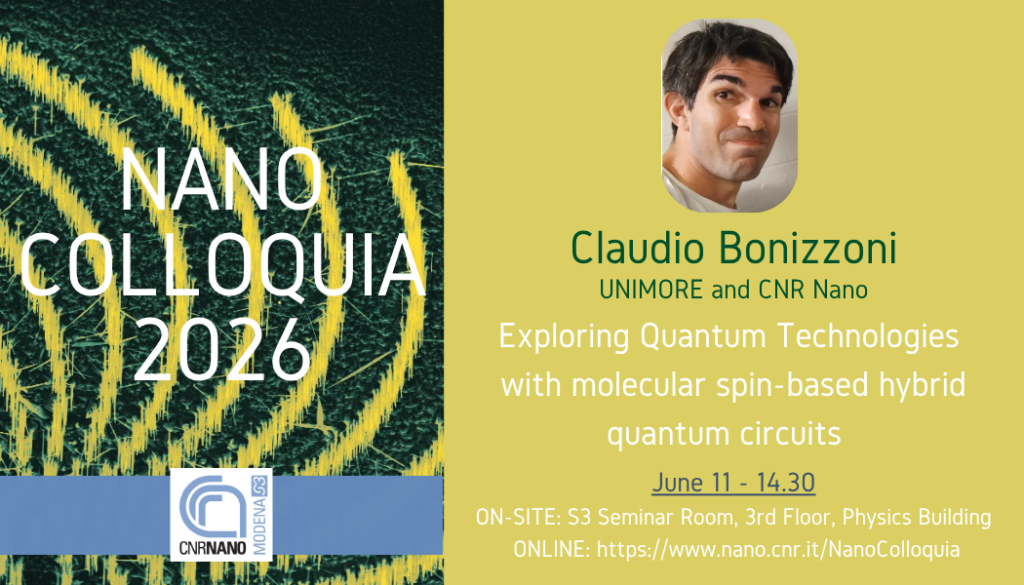
Claudio Bonizzoni will give the seminar “Exploring Quantum Technologies with molecular spin-based hybrid quantum circuits” as a part of the NANO Colloquia 2026 of the CNR NANO. Further information can be found at this link, while the abstract is reported below.
ABSTRACT: “This seminar presents our recent experimental achievements on the use of molecular spins in quantum technologies, especially when these are embedded into planar microwave (MW) superconducting resonators at cryogenic temperature.
We first consider the quantum sensing of magnetic fields [1,2]. Here, the phase of the spin echo is typically used to infer the parameters (e.g., amplitude) of an AC signal synchronized with the MW pulses driving the echo [1]. We show how this sensing scheme can be extended to the case of time-dependent signals which are not synchronized with the driving pulses [2]. The optimal sensitivity results from a trade-off between signal duration, signal strength and memory time.
We then discuss the viability of molecular spins as memories for information [3,4]. Along this line, electronic spins (S=1/2) offer an easy implementation [3], but at the cost of a memory capability limited by the electronic lifetime (memory time, Tm). Transferring information into nuclear spins (I) would overcome this limitation, also paving the way for the realization of quantum processors at RF frequency assisted by MW initialization and readout [4]. Using diluted VOPt(SOCPh)4 (S=1/2,I=7/2) crystals, we show that it possible to initialize spin coherence on electronic states (MW frequency), transfer it to the nuclei (RF frequency) and, finally, retrieve it back to the electronic states (MW frequency) for readout, after a time largely exceeding Tm [4].
Finally, we report on spectroscopic experiments performed at mK temperature and in the single MW photon regime [5]. We show that points of Perfect Absorption (PA, no outcoming photon) can be tailored using BDPA organic radicals (S=1/2) and the hyperfine levels of a VO(TPP) sample (S=1/2, I=7/2), both in the weak and up to the strong spin-photon coupling regime. These results hold potential for the realization of MW single-photon switches or MW modulators [5].
[1] C. Bonizzoni, A. Ghirri, F. Santanni, M. Affronte, npj Quantum Information, 10, 41 (2024)
[2] M. Lanza, C. Bonizzoni, O. Mironova, F. Santanni, A. Nicolini, A. Ghirri, A. Cornia, M. Affronte, Physical Review Applied 25, 034045 (2026)
[3] C. Bonizzoni, A. Ghirri, F. Santanni, M. Atzori, L. Sorace, R. Sessoli, M. Affronte, npj Quantum Information 6, 68 (2020)
[4] M. Lanza, O. Mironova, C. Bonizzoni, G. Bellini, A. Nicolini, A. Ghirri, R. Clérac, M. Rouzières, A. Cornia, M. Affronte, submitted (2026)
[5] C. Bonizzoni, D. Lamberto, S. Napoli, S. Günzler, D. Rieger, F. Santanni, A. Ghirri, W. Wernsdorfer, S. Savasta, M. Affronte, Nature Communications 17, 470 (2026)
The seminar is realized in the framework of the funded projects
-National Quantum Science and Technology Institut (NQSTI) PE00000023 SPOKE 5- call N. 1 Project “Addressing molecular and Spins with MIcrowave puLsEs through Superconducting circuits for QUantum Information Processing (SMILE-SQUIP)”
-US Office of Naval Research award N62909-23-1-2079 project “Molecular Spin Quantum Technologies and Quantum Algorithms”
-The International Excellence Grants Program of KIT through the University of Excellence concept”